


Guides · The world
Keeping animals
Feed a wild animal its favorite food and it can become yours to keep. A kept animal is saved with your world, never wanders off for good, and gives you things on its own rhythm: wool, milk, eggs, feathers, honey. There are 14 kinds to keep, from the farm's cows and hens to camels and a donkey.
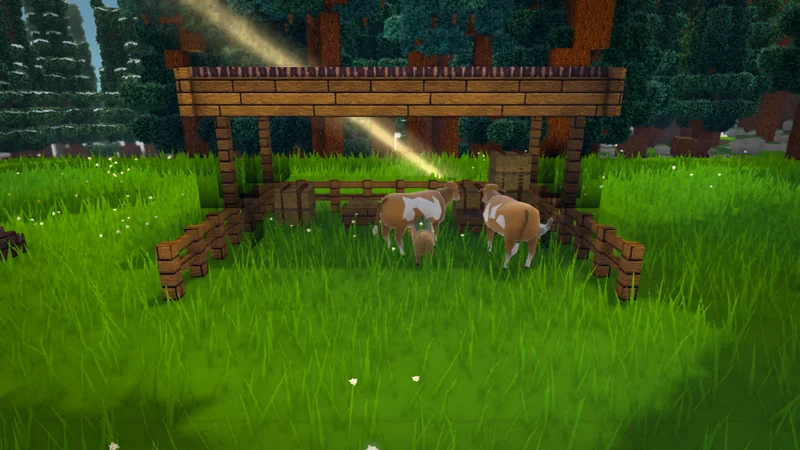
Keeping is gentle. Nothing you keep sickens or dies for want of care; a hungry animal just stops giving until you feed it. What you work at is a good pen and a good routine.
Which animals you can keep
Feed an animal, breed it or lead it with a Tether, and it is kept. One claim holds up to 40 kept animals, and a world keeps up to 300 in all. A fence or wall one block high holds an animal in a pen.
Here is every kept animal, what it eats from your hand and what it can give. Every one of them breeds.
| Animal | Eats | Gives |
|---|---|---|
| Wild Boar | Carrot, Potato, Beet, Beans, and Tomato | Company only |
| Cow | Wheat and Corn | Milk |
| Chicken | Wheat Seeds, Barley Seeds, Flax Seeds, Sunflower Seeds, Corn Seeds, Rice Seeds, Cotton Seeds, and Sorghum Seeds | Eggs and Feathers |
| Camel | Sorghum, Prickly Pear, and Dates | Wool |
| Mountain Goat | Wheat and Barley | Wool and Milk |
| Ibex | Wheat and Barley | Horn |
| Ostrich | Corn and Wheat | Feathers |
| Wild Horse | Wheat, Carrot, and Hedgeberries | Company only |
| Warthog | Potato, Carrot, and Corn | Rooting |
| Tapir | Banana, Melon Slice, and Hedgeberries | Company only |
| Rabbit | Carrot, Wheat, and Leek | Soft coat |
| Sheep | Wheat, Wheat Seeds, and Carrot | Fleece |
| Goose | Wheat Seeds, Wheat, and Corn | Down |
| Donkey | Carrot, Wheat, and Apple | Company only |
A wild animal that is not yet kept takes only the food in its row, from your hand, and may let you near. Feed it until it is yours. The Sheep, the Goose and the Donkey live in the wild too. The Goose rises on a shore, where open water is near.
Feed two animals of the same kind close together and they walk to each other and have a young one. A fed adult stays ready to breed for 30 seconds. The parents rest 5 minutes before they breed again, and the young one grows up in about 20 minutes. Feeding it helps it grow.
How an animal fares
Every kept animal is in one of four states: Hungry, Fed, Content or Uneasy. A meal lasts about 10 minutes. After that the animal is hungry and gives nothing until you feed it again. A fed animal with enough comforts round it is content, and a content animal is the one that gives the most.
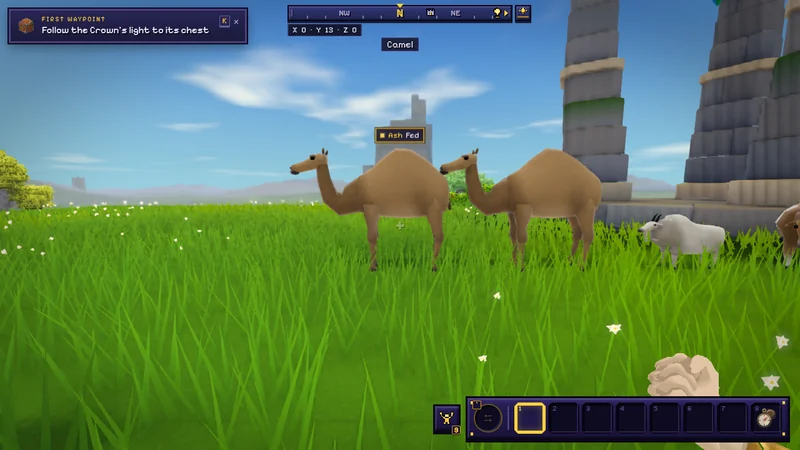
To read an animal, aim at it and use it with an empty hand. The line tells you its name, how it fares and what it wants most: Wants food, Wants water, Wants shelter or Wants bedding.
Comforts
A fed animal is content when two of three comforts are near it. A content animal gives about 25 percent sooner, and a little more of some things. The game looks again every few seconds, so a new trough or a new roof counts soon.
- Water. Water or a Water Trough within 4 blocks.
- Bedding. A Hay Bale, wool or yellow wool within 3 blocks.
- A roof. Any solid block straight over it, up to 4 blocks.
Thunder, hail and sandstorms unsettle an animal with no roof over it. It is fed but not content while the weather lasts. Nothing is hurt by it.
What they give
Each kind of product has its own rhythm. Some fall at the animal's side, some wait for a tool.
| Product | You get | How | Every |
|---|---|---|---|
| Wool | 1 White Wool | Falls at its side | 20 min |
| Milk | 1 Milk Bucket | An empty Bucket | 10 min |
| Eggs | 1 Hen's Egg | Falls at its side | 5 min |
| Feathers | 1 Feather | Falls at its side | 15 min |
| Horn | 1 Ibex Horn | Falls at its side | 60 min |
| Fleece | 3 White Wool | Shears | 20 min |
| Soft coat | 1 White Wool | Shears | 15 min |
| Rooting | 1 Brown Mushroom | Falls at its side | 15 min |
| Down | 2 Feather | Falls at its side | 10 min |
A hungry animal gives nothing. Things that fall at its side only fall while someone is near, so nothing piles up while you are away and nothing is owed to you after. A content animal gives about 25 percent sooner. You cannot shear or milk an animal kept on another player's land.
Shears take a coat only when it has grown back. You can watch it grow in 4 steps on the animal, and a coat not yet grown gets the message "Its coat has not grown back yet." A young animal is too young to shear.
Farm pieces
A few things you can build and set down make a pen better. Each one is in the crafting window.
| Piece | What it does |
|---|---|
| Shears | Takes a grown coat from a sheep, a rabbit or another animal with a coat. It lasts 238 uses. |
| Hay Bale | Bedding: an animal within 3 blocks counts it as a comfort. |
| Water Trough | Water: counts as a comfort within 4 blocks. A thirsty animal walks to it within 6 blocks. |
| Feed Trough | A trough you fill with food. A hungry animal walks to it and eats. |
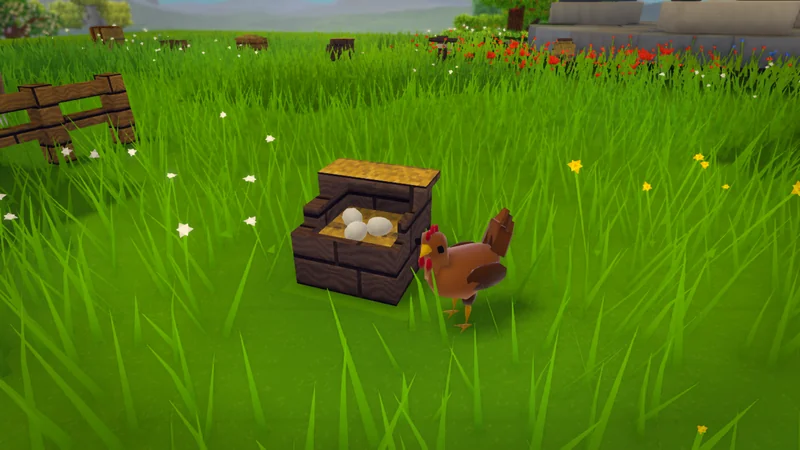
| Nesting Box | Eggs and down laid within 4 blocks go into it while it has room. |
| Hitching Post | Tie the animals you lead to it with a Tether. |
| Skep | A hive. Set it on claimed land among flowers and bees settle in. |


Bond and your herder
Every meal you give an animal raises its bond with you by one, and by two if it is the food it likes best. A bond tops out at 10. Below 3 the animal reads as "Wary of you", from 3 as "Trusts you", and from 7 as "It knows you". The player an animal knows is its herder.
An animal at a bond of 7 or more, whose herder holds a food it eats, walks over to them from up to 10 blocks away.
A Tether leads an animal like a rope: you can lead 4 at once, and the rope snaps if you go more than 12 blocks away.
Traits and lines
Some animals carry a trait. A wild animal you keep has one 15 percent of the time, a new one can turn up in a young animal 8 percent of the time, and a parent's trait passes to its young 50 percent of the time. An animal has 2 traits at most. Each young one born in your herd adds one to its line: the Herd Book calls it "Second of its line", then "Third", and so on.
| Trait | What it does |
|---|---|
| Thick Coat | A coat gives 1 more Wool. Only animals with a coat. |
| Steady | Gives its products sooner. |
| Hardy | A meal lasts longer before it is hungry. |
| Gentle | Each meal adds more to its bond. |
| Quick to Grow | A young one grows up sooner. |
The Herd Book
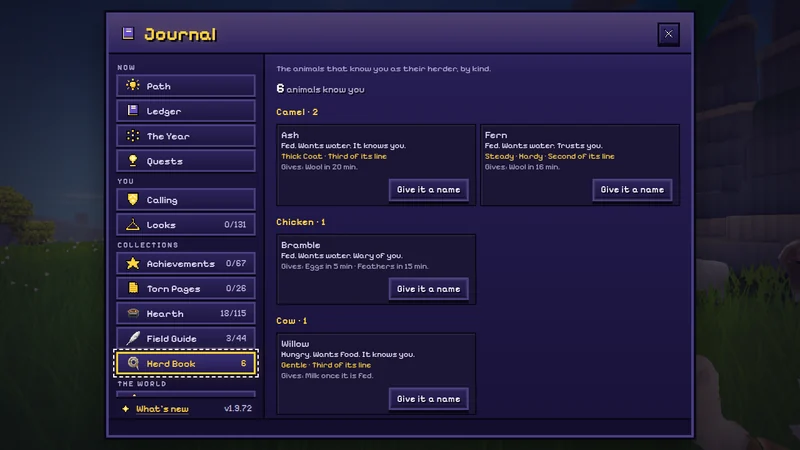
The Herd Book is a page in your Journal. It lists every animal that knows you as its herder: its name, how it fares, its bond, its traits and line, its parents, and what it gives and when. You can also type /herd in the chat for a short reading. From the page you can give an animal a name, chosen from a list of 62 names, so no one has to type one.
Working animals
A Camel, Wild Horse, and Donkey that you are the herder of and that knows you (a bond of 7 or more) can work for you. Put a Saddle on it and it carries you. Its pace is never above a Roadhorn's.
Use a Laden Chest on it and it carries saddlebags: a store that travels with it and is saved. How much it carries depends on the animal. Only its herder opens its saddlebags. If it falls, what it carried lies where it fell.
- Camel, 9 slots
- Wild Horse, 6 slots
- Donkey, 6 slots
The night
Some foes of the night, the Waned and their kin, go for an open herd with no player to hunt. They scatter it. The animals run for 12 seconds and then walk back to where they stood. No kept animal is hurt, and you are told if it happens: "Something in the dark has scattered your herd."
An animal is safe when it has a roof over it, when it stands penned (a fence, wall or built block within 8 blocks in each of the four directions), or when a guardian stands within 12 blocks. The Goose and Donkey are guardians.
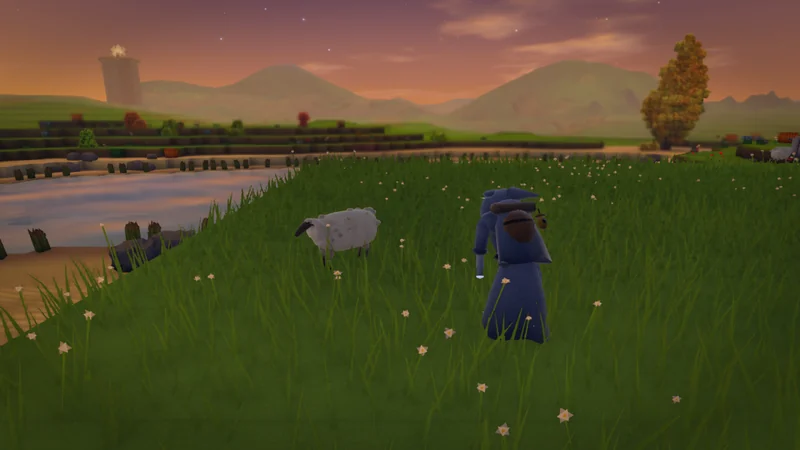
Bees
A Skep set on claimed land with flowers near it fills with bees, and gives Honey every 10 minutes while a player is near. With 6 flowers within 5 blocks it gives every 5 minutes. Take the honey by hand or with a Glass Bottle. Strike a skep with bees in it and they sting you with Blight for a few seconds.
A good first pen
- Fence all four sides, so the pen counts as safe at night. Anything built within 8 blocks in each direction counts.
- Put in a Water Trough, or a pool.
- Put a chest or a Feed Trough with their food within 4 blocks: a hungry animal eats from it on its own.
- Roof one corner, and set a Hay Bale there.
- Use each animal with an empty hand to read how it is, and open the Herd Book when you have a few.
If an animal will not give, it is usually hungry: "It is too hungry to give milk." is the line you get when you try to milk one.
Next: The Hold. All sections: the guides.